We’ve added 7 new items to http://www.showhistory.comin the last week, but I am working hard on some new long form articles. We’ll get caught up next week, as we have a backlog of 30-something images scanned and ready to be uploaded.
Today we present the thirteenth installment of my weekly newsletter about interesting items you can find on the site as a member.
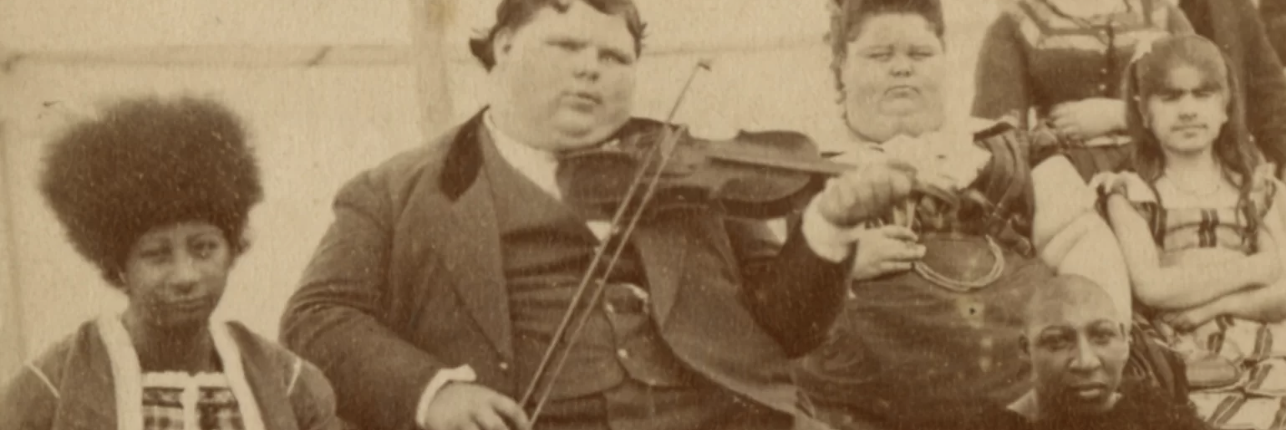
There not very many images in the archive that are spectacular enough to merit their own newsletter topic. Today we present one of those– a likely unique image– a stereoview– taken inside the sideshow tent, backstage if you will, of the 1872-73 cast of P. T. Barnum’s Great Traveling Exposition and World’s Fair.
Shown in casual repose here is the greater part of the sideshow cast that year including: “Bearded Woman” Annie Jones, “Aztecs” Maximo and Bartolo, “What Is It” Zip, “Albino” Pearl Foster, and “Fat Siblings” John and Mary Powers.
You can see the photo and the description here in high resolution:
2. And significantly, two 1920s photos of Percilla Bejano, whom we profiled in Newsletter #8, have recently been added to showhistory.com. These both show legendary showman Carl Lauther, Percilla’sadopted father, and his incredible bannerlines. They also feature a very young Percilla on the bally stage.
3. If you would like to support a LIVING sideshow legend, please consider purchasing a print by our good friend and mentor, Johnny Meah. All funds collected go direct to Johnny! Here’s our newly created STORE: https://showhistory.com/shop/
You won’t see this week’s image anywhere else. A highly regarded photographic dealer and historian has called this “the most significant stereoview I’ve seen in 40 years.”
We’ve added 12 new items to http://www.showhistory.comin the last week, and updated several performer pages and venues.
Today we present the twelfth installment of my weekly newsletter about interesting items you can find on the site as a member.
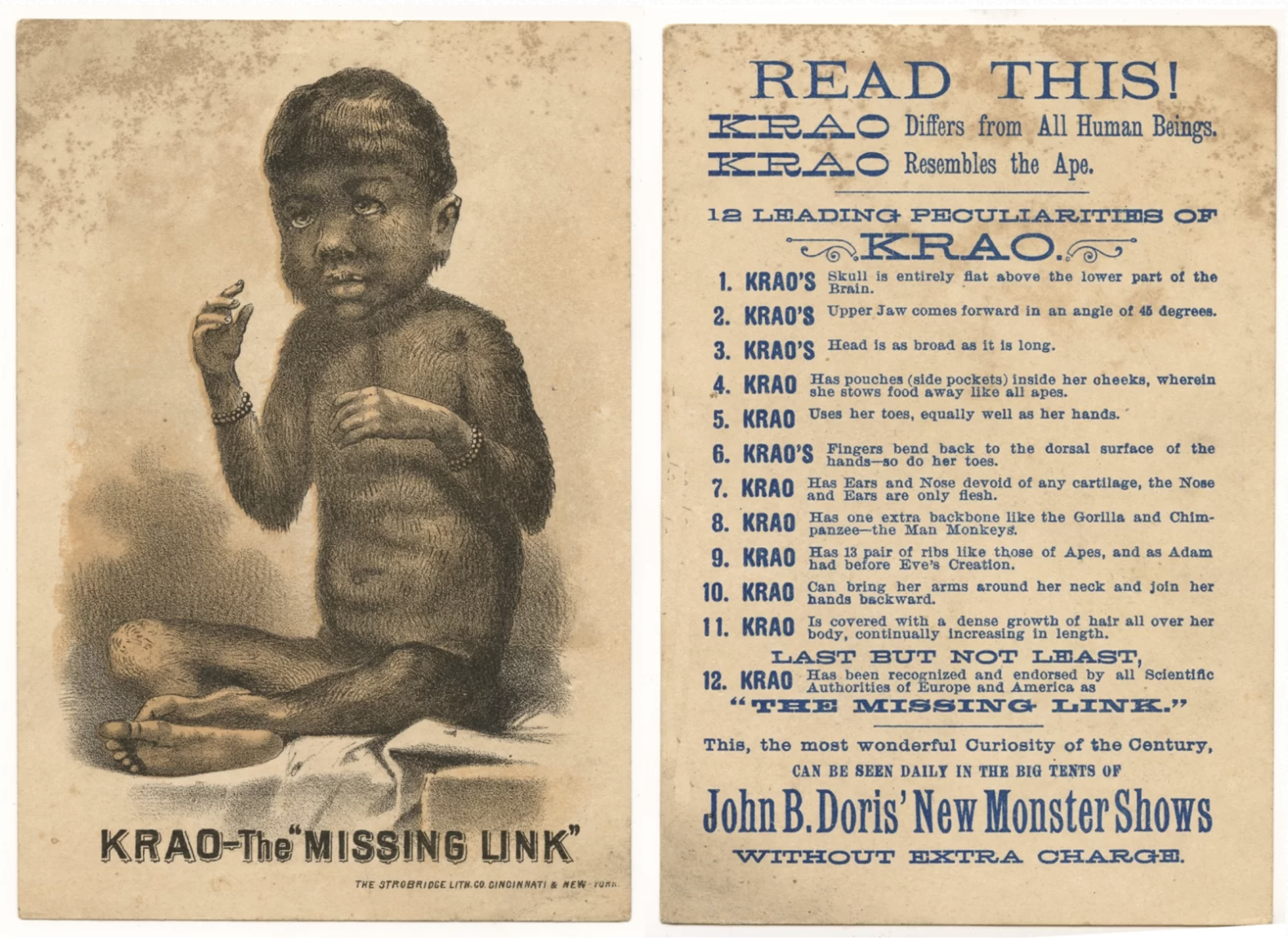
This week we highlight a truly iconic and important performer of the late-19th Century and early 20th Century sideshow and dime museum– Krao Farini.
Krao
was billed as a “Missing Link” but in truth she simply had the condition hypertrichosis. Unlike performers like Jo-Jo “the Russian Dog-Faced boy” and Lionel “The Man With The Lion’s Face,” who both had fine silky hair, Krao’s form of hypertrichosis was of the Congenital Hypertrichosis Terminalis variety, producing dense, coarse, dark hair covering her body from birth, similar to Percilla Bejanowho we covered a few weeks back.
The archive contains 16 items of Krao, including:
• The very first two images distributed of Krao as a 6-year old,
• The first is a very fine 1882 portrait of a sweet-faced child taken before she was brought to England that year,
• Contrasting the first, is a second 1882 image– a painted promotional cabinet card depicting her as a very savage and wild figure,
• Three of her earliest American and English portraits taken with her guardians Farini and Shelley,
• Three versions of her color trade card while Krao was with “John B. Doris’ New Monster Shows,”
• A very late career postcard of Krao at 45 years old, at Coney Island,
• And more!
Krao Farini (1876 – 1926)
from Elizabeth Anderson:
In his last letter to rival Herbert Spencer, the great Charles Darwin spoke of a “missing link” between man and ape, which would prove once and for all his theory of humans’ evolutionary descent from apelike ancestors. The idea of the missing link was seized upon by countless opportunists seeking to earn a quick buck and perhaps make history at the same time. Dozens of humans with genetic anomalies, from the very hairy to the mentally handicapped, were presented by enterprising showmen as “Darwin’s Missing Link”.
Perhaps the most famous of these was Krao, a Thai girl born around 1872 [actually 1876] in a small village in Laos. A thin layer of coarse black hair covered the child’s body from head to toe, and she was also endowed with supernumerary teeth, a secondary feature of hypertrichosis, and hyperextensible joints, a common genetic variation in humans. Krao was first discovered in Laos by a Norwegian explorer, Karl Bock, and his assistant, Professor George Shelly, scouts for the showman G.A. Farini who had heard of Barnum’s success with the Burmese hairy family (Mah Phoon, Moung Phoset and Mah Me) and sought a hairy freak of his own.
Following leads from local people, Bock stumbled into Krao’s native village, where a mother and father were exhibiting their remarkable hairy daughter as a curiosity. When the little girl wandered away from her parents, they called her back with the word krao, which Bock assumed to be her name. Bock and Shelly paid the parents $350 to take the child with him back to England.
The complete article is continued here for member/subscribers.
We’ve added 20 new items to http://www.showhistory.comin the last week, including many updated performer pages.
Today we present the eleventh installment of my weekly newsletter about interesting items you can find on the site as a member.
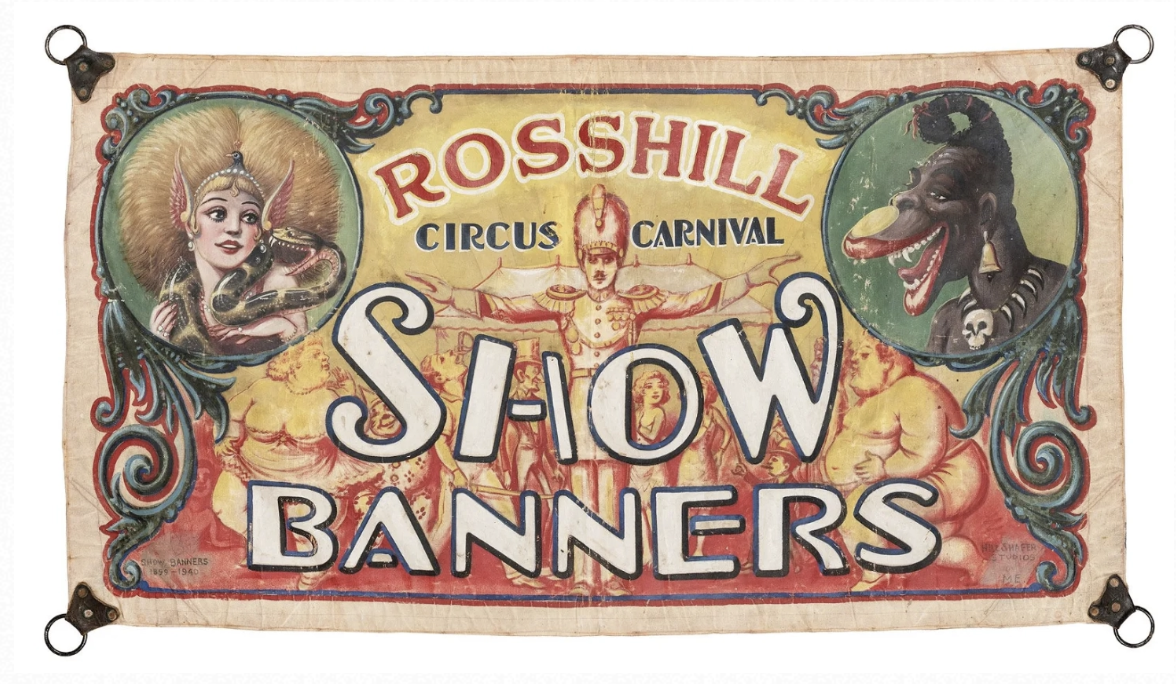
This week we highlight one of the great sideshow artists of the early-20th Century, banner painter, Cad Hill.
Lesser known than the generation of painters that followed him, like Fred Johnson, Snap Wyatt and Johnny Meah, Cad Hill is an important name in the history of banner painting.
Famously, Fred Johnson called Cad “…
too good for banner work.”
Cad Hill (1871 – 1947)
Clarence C. “Cad” Hill of Falmouth, Maine is considered one of the finest banner painters to ever wield the garish colors and outlandish imagination that the great sideshows of the 1910s, 20s, and 30s demanded.
Cad was born in 1871 in Sandwich, New Hampshire, and was legless due to an accident that occurred around 1915. He got started in the late-1880s as a sign painter and scenic artist in Lynn, Massachusetts. In 1890 he did his first show work, painting up a lobby display for a local store show, and as it returned each winter, he got to know the show folk. By 1894 his reputation spread to Boston, and he soon was the house artist for the renowned dime museum Austin and Stone’s.
The complete article is continued here for member/subscribers.
We’ve added just a handful of new items to http://www.showhistory.comin the last week, preparing a major upload this weekend.
Today we present the tenth installment of my weekly newsletter about interesting items you can find on the site as a member.
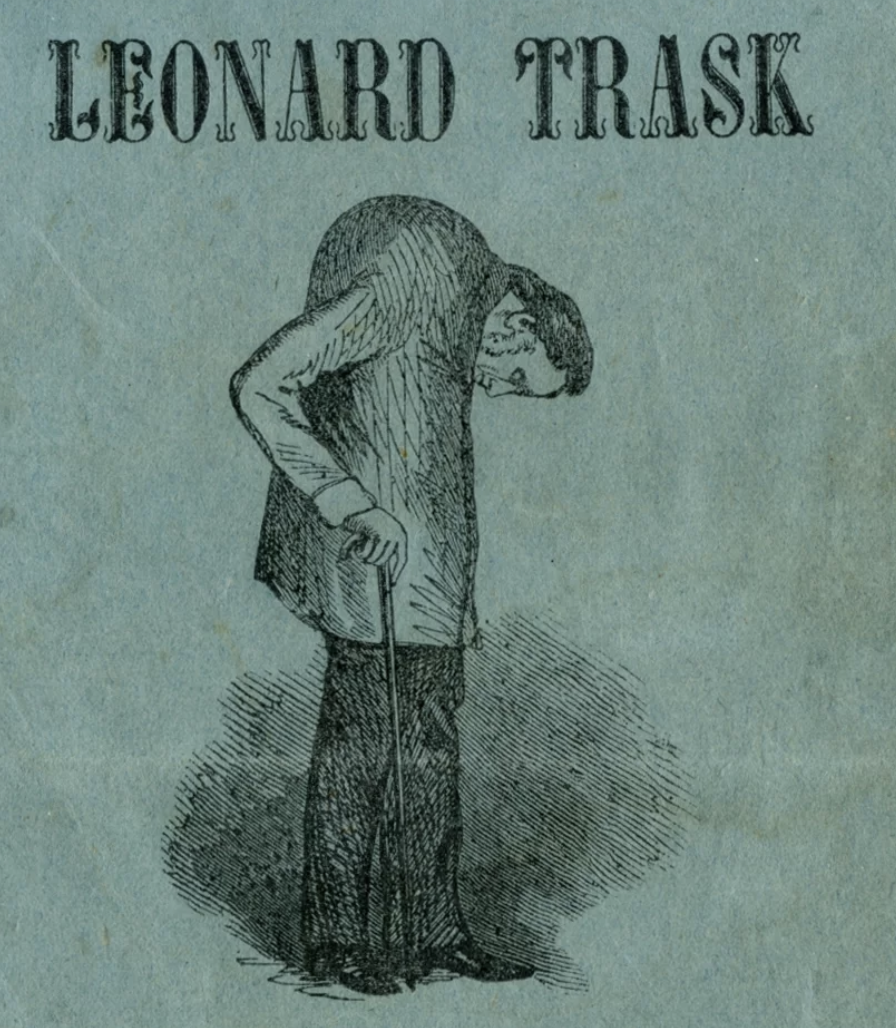
This week we highlight a performer who challenges the very boundaries of what we cover on showhistory.com– Leonard Trask “The Wonderful Invalid”.
Though the distinctions between the genres of performers is often pliable, in our delving into the history of the business, we find that “the stage” can be found in many guises. Whether circus ring, sideshow bally stage, vaudeville stage,or “the stage of the streets,” there is only one constant– the player– who is paid to perform.
Trask worked the stage of the streets. He was in the genre of handicapped performer that did not perform in the sideshow, though he made his living by displaying his anomalous body.
This week the complete article is FREE, perhaps giving those who haven’t yet subscribed a taste of the kind of material we present.
The showhistory.com archive contains 5 original items on Leonard Trask:
* The four (4) known versions of his pitchbook, first published in 1857
• The only known original photograph of Trask.
Leonard Trask “The Wonderful Invalid” (1805 – 1861)
In the strange history of those who made a living from an acquired deformity or mutilation, perhaps none is stranger, or more ill-starred than Leonard Trask.
Born in Hartford, Maine on June 30, 1805, Trask acquired his odd contortion of neck and spine in 1833, when a “luckless hog” took fright, and ran beneath his horse’s hooves. Flying over his horse’s neck onto his own neck, Trask eventually crawled back to his home on a journey that took several days. Amazingly, Trask didn’t snap his spinal column, though there is some evidence that landing on his head was not a lesson for future caution.
We’ve added 10 new items to http://www.showhistory.comin the last week, and updated or added about a dozen performer bios and venue records.
Today we present the ninth installment of my weekly newsletter about interesting items you can find on the site as a member.
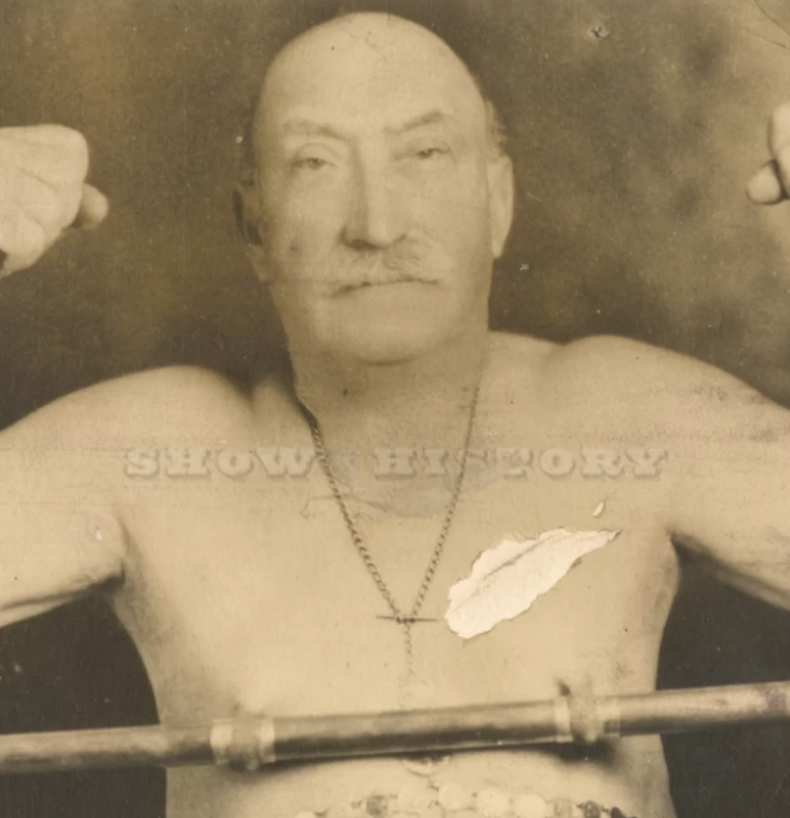
This week we highlight a performer who was truly ahead-of-his-time– Captain Ringman Mach. Like the better-known performerRasmus Nielsen, Mach also had his nipples
pierced, and was able to lift huge weights with them– though Ringman Mach was the originator of the act.
The showhistory.com archive contains 8 original items on Mach, including:
* The earliest pitch card of Captain Mach, in his Captain’s uniform, ca. 1907
• Another early pitch card of Captain Mach, displaying his piercings, ca. 1915
• An incredible Fred Johnson single-o sideshow bannerline of Mach’s set-up in Argentina in 1932
• Two real photo postcards from the 1930s, showing highlights of his incredible act
• And more!
Captain Ringman Mach (ca. 1875 – 1957)
His true full name unknown, Captain Ringman Mach, a German strongman, born around 1875, was an extraordinary, ahead-of-his-time body-modder who had his nipples pierced and the holes enlarged in order to lift heavy weights and bend iron bars attached to the piercings in his chest.
The story he told of how he acquired his piercings changed from year to year, but usually featured being tortured and the piercings the result of his ordeal. From Africa, to China, to South America, to Mexico, to New Guinea, the natives and/or barbarians who captured and tortured him were interchangeable.
Captain Mach first appears in the United States in August of 1906, far down on the bill, as “Captain Ringman Mack,” at The 9th & Arch Museum in Philadelphia, where he is billed as “European Dagger King,” and “the Painless Wonder.”
The illustrated article is continued here,where you will find perhaps the first full history written about Ringman Mach.
We’ve added a dozen or so new items to http://www.showhistory.comin the last week, and updated or added 15 performer bios and venue records.
Today we present the eighth installment of my weekly newsletter about interesting items you can find on the site as a member.
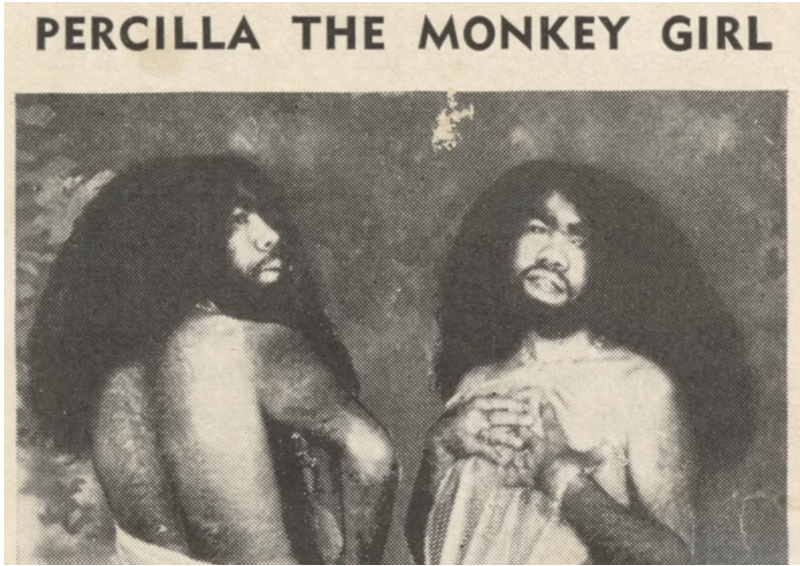
This week we highlight one of the most legendary sideshow performers of the 20th Century with a 70-year career– Percilla Bejano, “The Monkey Girl.”
The showhistory.com archive contains 20+ items on Percilla, including:
* The complete series of four (4) real photo postcards made of Percilla and her parents in 1913 when she was 2 years-old
• A one-of-a-kind 1970s souvenir pinback button featuring Percilla made for showman John Bradshaw
• A Christmas postcard from Percilla and husband Emmitt featuring their three dogs
• The only known photos of Percilla and Emmitt’s daughter who tragically died at 14 weeks
• A rare photo showing the entire 1950 sideshow cast of Ringling Brothers & Barnum Bailey Circus sideshow with Percilla and Emmitt
• The earliest known piece that describes Percilla and her husband, “Alligator Skinned Man” Emmitt, as “The Strangest Married Couple.”
• Two extraordinary interior photos of Percilla’s adopted father Carl Lauther’s store show in Atlanta
Percilla Bejano (1911-2001)
by Elizabeth Anderson
Percilla Roman was born in Bayamón, Puerto Rico, on April 26, 1911. At birth she had not only a full head of dark hair, but also a layer of coarse dark hair covering her entire face and body. She also had two rows of teeth. Of her parents’ seven children, she was the only one with any sort of abnormality.
The Romans brought their daughter to New York City on several occasions, trying to determine a cause – and possibly a cure – for her hairiness. The experts agreed that her condition was the result of a genetic abnormality and could never be cured. Frustrated, and in need of funds to support his wife and other children, her father placed her on exhibition when she was three years old. When she was six, her father died and the show’s owner, Carl Lauther, and his wife adopted her.
The article is continued here,where you will find an excellent bio and history of Percilla.
We are still working on longer pieces to be premiered in the next few months, including articles on on of the late-19th Century and early-20th Century’s greatest sword swallower, Chevalier Cliquot.
Today we present the seventh installment of my weekly newsletter about interesting items you can find on the site as a member.
This week we highlight one of the great showmen of the early-20th Century, though little talked about today, he invented the 10-in-1 sideshow, created the very first pit show, and was the first manager of Hubert’s Museum— Walter K. Sibley.
Self-styled as “The Barnum of The Little Fellows,” Sibley had a long and interesting career that touched most of the outdoor show business.
Walter K. Sibley [Walter C. Zebley] (1873-1949)
“People will look at pumpkins and cows and pigs,
but they’ve got to have their freaks on the side.”–January 1921, Walter K. Sibley (speaking on a proposed ban of freaks by The American Fair Association)\
Walter Kern Sibley was born December 10, 1873 in Philadelphia, though he sometimes erroneously reported it to be Boston. Likewise his birth name of Walter Curran Zebley was discarded in favor of the show name Walter K. Sibley.
Sibley is widely credited as being the originator of the 10-in-1 sideshow. In addition, some say he was the first showman to create a pit show.
Emblematic of great showmen of every age, he took stupendous risks with capital, made enormous piles of money, and then, just as spectacularly, more than once, found himself without a penny to his name.
The full 1,800 word illustrated article is continued here,where you will find a long bio, and four interesting original items related to Sibley, including an original postcard sent from Laurello “The Man With The Spinning Head” to Walter Sibley at Hubert’s Museum.
We are caught up with our plan to add 10-20 images per week with over 30 archive images and 7 performer bios created in the last 5 days.
Go to our Latest Additions to see all the new stuff– Latest Additions – Show History. Many of the new images are related to an upcoming long article on the preponderance of Little People and sideshow performers used as mascots/spokespeople for commercial products (Freaks in Advertising).
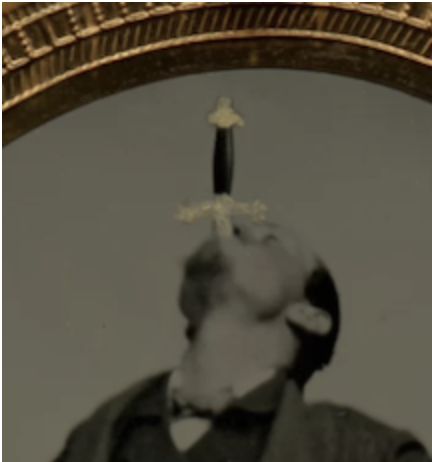
In today’s sixth installment of my weekly newsletter about interesting items you can find on the site as a member we present just one specific item— the earliest image extant of a performing sword swallower.
This image dates from 1855-1860, and by the very nature of the ambrotype photographic process, it’s a one-of-a-kind direct positive– unique with no duplicates.
Above is a small detailed portion of the image, that is shown in full resolution, and fully explored and documented on the showhistory.com site, here:
A few more bonus items for this week’s newsletter:
1. While you are looking at unusual sword swallower images, check out another one– from circa 1875, a very raredouble cased tintype of another unidentified sword swallower. This is the only known tintype image of a sword swallower performing!
2. For those who enjoyed our newsletter three weeks back featuring “Armless Wonder” Paul Desmuke, we tracked down the actual marriage certificate he wrote with his foot, where he crossed out witness my hand, and wrote in the word foot.Incredible stuff. You can see this notarized, document from Atascosa County, Texas here.
Here’s the fifth installment of my weekly newsletter about interesting items you can find on the site as a member.
In these weekly newsletters I’ll give you a teaser of what you will find on the website as a member.
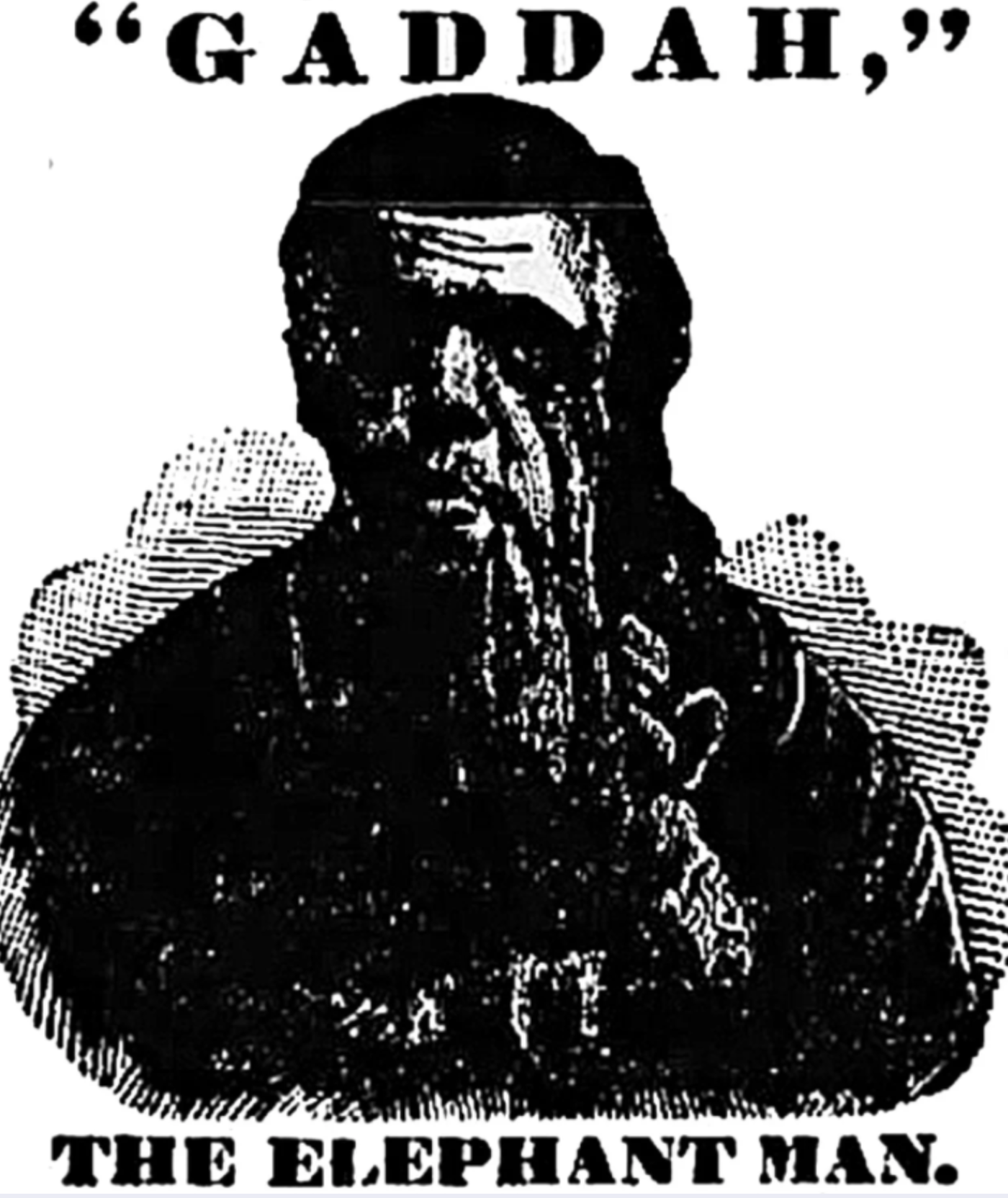
This week we highlight the very obscure, and fascinating, Gaddah, the most spectacular performer you have never heard of.
And be prepared, as his story is a long and circuitous one.
Gaddah “The American Elephant Man,” was on the dime museum stage for a mere 4-months back in 1891-1892, but his story is emblematic of the rise and fall of many virtually unknown performers with physical anomalies who graced the world of show with their countenances. Gaddah was a sufferer of neurofibromatosis, the same supposed disease of Joseph Merrick, the original “Elephant Man.” (Though Merrick has most recently been said to have had Proteus Syndrome, rather than neurofibromatosis.)
Gaddah [Juan Jose Antonia] (1866? – ?)
By nature of its marginality, the freak trade contains more lost stories than any other branch of show business. In the three decades from 1870 to 1900 the rage for dime museums begat and extinguished more freak performers than any other time in history. And no freak better than Gaddah personifies the era’s ability to plunge a man from the heights of notoriety and fame into absolute obscurity and show history perdition.
Unlike the famed English “Elephant Man,” Joseph Merrick, Gaddah, the American “Elephant Man” is less than a footnote today.
This despite his extraordinary and unique physical appearance, and his dramatic capacity to sell inexhaustible numbers of tickets. This evidenced by the fact that no one has written a sentence about Gaddah in more than 120 years, until now.
Here’s the fourth installment of my weekly newsletter about interesting items you can find on the site as a member.
Showhistory.com is not just an image archive. It is a historical written repository containing an ongoing history of the sideshow and allied arts.
In these weekly newsletters I’ll give you a teaser of what you will find on the website as a member.
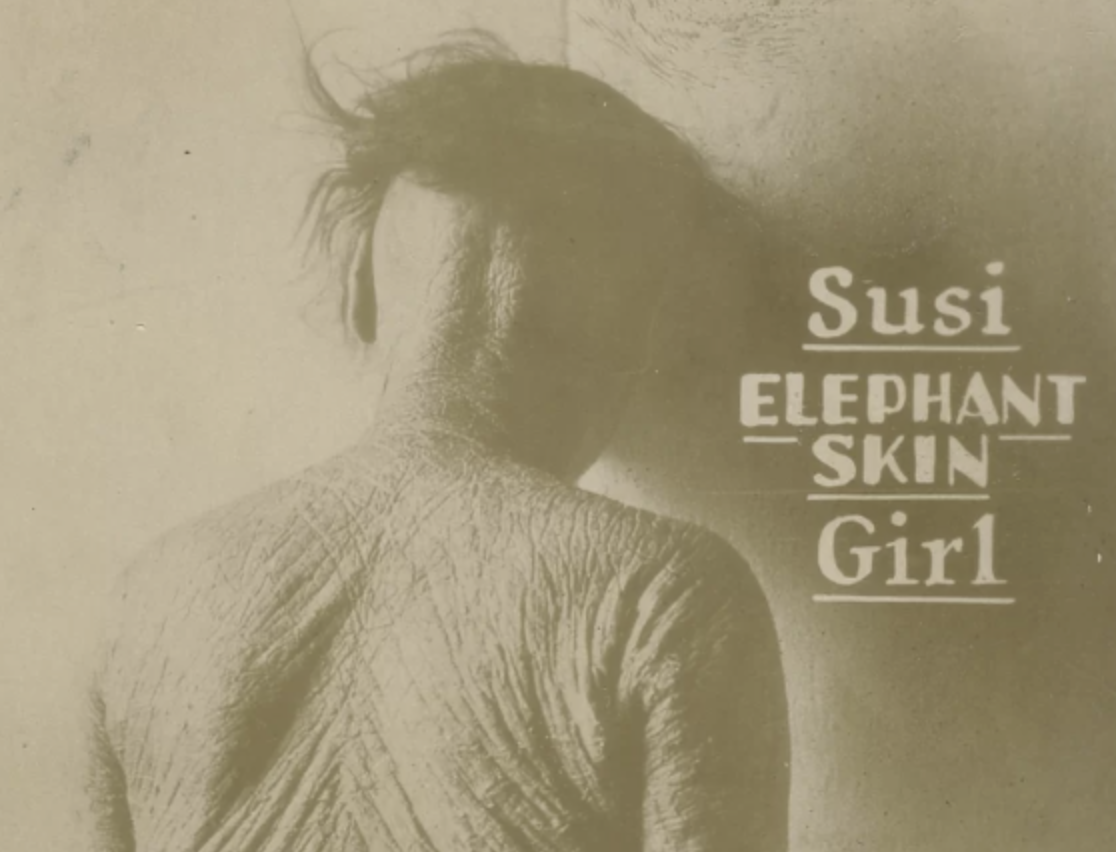
This week we highlight Susi (or Susie or Suzi) “The Elephant-Skinned Girl,” who had a 40 year career appearing with circuses, carnivals, dime museums, store shows, at Hubert’s Museum and Coney Island.
Susi is one of the most recognized performers who suffered from ichthyosis, known in the business and to the public variously as elephant, alligator, crocodile, or even armadillo-skinned people. We’ve documented nearly 20 such performers, but Susi stands out for several reasons you will find out.
Susi [Charlotte Vogel] (1908-1976)
Charlotte Linda Vogel was born in Charlottenburg, Berlin, February 26, 1908, the only person in her family with her peculiar skin condition. (Although she claimed at various times to be Austrian or Swiss, she was definitely German.) Hers was a different type of ichthyosis than that of her “alligator-skinned” contemporaries; Charlotte was not scaly, but rather covered all over in a thick, leathery, grey skin that formed deep creases at the joints. Epidermolytic hyperkeratosis (EHK) seems to be the most likely diagnosis.
She could not sweat and stayed cool by rubbing herself with ice, and had to lubricate her skin with baby oil several times a day to prevent painful cracking. She also could not produce tears and could only close her eyelids by sliding them down with her fingers. Charlotte was able to maintain a normal appearance from the neck up by peeling the excess epidermis from her face every night, though in her pitch book she claimed to have rid her face of scales with a type of X-ray treatment.
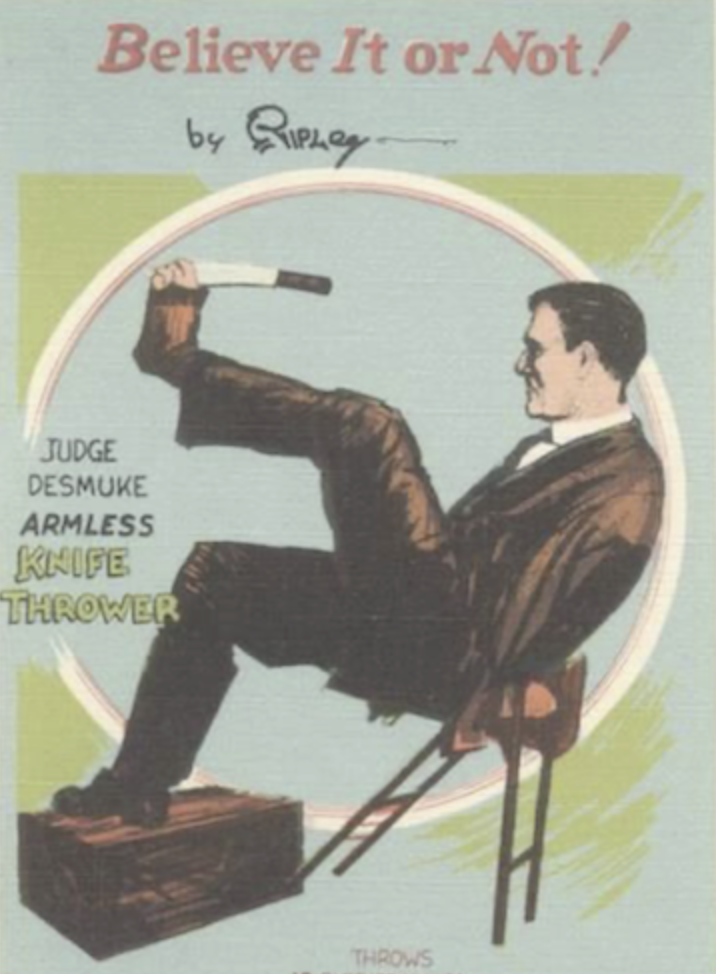
This week we highlight Paul “Judge” Desmuke, a man born without arms who came to be the “foot double” for Lon Chaney when he played an armless knife-thrower in The Unknown, another amazing film with a macabre carnival theme from Tod Browning. This is another must-see film from the director of Freaks.
Paul Desmuke is not very well remembered today, but he was perhaps the greatest armless performer of the 1920s, 30s and 40s. Paul was a versatile and talented performer who played the violin and guitar with his feet and was also a knife-thrower.
Paul Desmuke (1876-1949)
Paul Desmuke was born on April 26, 1876 near Poteet, Texas, in a small district known then as Four Points. Paul was born without arms, and grew up in Amphion, Texas. Later he became Justice of the Peace in Amphion, and thus had the nickname Judge.
Desmuke had at least six siblings, and reportedly his mother refused to allow him to join the sideshow, despite his lack of opportunity for work in small town Texas. His break came in 1902 when in the Atascosa County Precinct’s three justices of the peace resigned. Desmuke applied for and was accepted as a replacement. The 26 year old handled (footled?) duties such as accepting criminal complaints, ruling on cause of death, pronouncing citizens dead, as well as performing marriages.
Full article continued here on http://www.showhistory.com, where you will find 15 original items on Desmuke:
• Including the only known photo of Desmuke in his stunt double costume for Lon Chaney in the film The Unknown,
• An incredible photo of a 50-foot bannerline featuring Desmuke on the Johnny J. Jones Show in 1907,
• A certified copy of a foot-signed marriage certificate when Desmuke was Justice of The Peace,
• A 1919 bannerline and bally stage photo on the Al G. Barnes Circus sideshow,
• Two family photos with Desmuke, his siblings and friends.
Showhistory.com is not just an image archive. It is a historical repository of the lore and history of the sideshow.
We bust the myths about performers, make connections between different eras of the business, and right the many inaccuracies found and repeated in both books and websites everywhere.
In these newsletters I’ll give you a teaser or excerpt of what you will find on the website as a member.
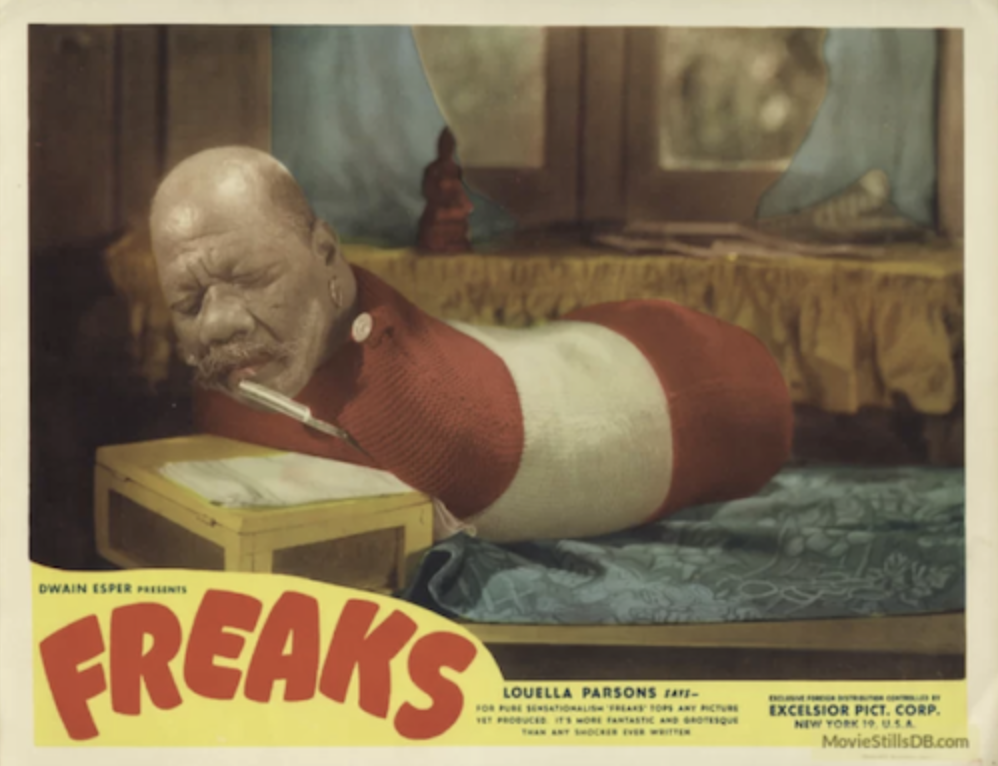
This week we highlighted Prince Randion, another unforgettable performer of the 1910s, 20s and 30s, who is most well-known for his incredible role in Tod Browning’s 1932 film, Freaks.
Again, we find ourselves debunking and correcting some common misnomers about the great and iconic performer.
Like Grace McDaniel who we profiled last week, Prince Randion’s very name is often misspelled, and his origins are clouded by oft-repeated, and unsubstantiated info found in books and on the internet.
Prince Randion (1871-1934)
“Some of the newspapers speak of Randion as being a Hindoo conjurer. Such is not the case. Randion is a Hindoo born without arms or lower limbs, and is the latest freak to invade America….” — Harry Houdini, 1906.
Though Houdini was already famous in both Europe and America when he wrote the above, he was only just six or so years out of the dime museum circuit himself. The great conjuror knew acts like Prince Randion’s very well.
What Houdini may not have known, unless he actually watched Randion perform, was that the limbless performer did nearly everything a man with his physical uniqueness should not have been able to do. That Randion could not do magic like Mathew Buchinger hardly hurt the performer’s draw over his 30 year run.
Full article continued here on http://www.showhistory.com, where you will find 13 original items on Randion:
• Including the very earliest photo of him BEFORE he started in sideshows in the USA,
• His pitchbook from Coney Island,
• His appearance with Schlitzie in 1925,
• AND a 1907 10-in-1 sideshow that presents Randion as Caucasian on their banners.
With the relaunch of http://www.showhistory.com I am going to attempt to do a weekly newsletter about some interesting items you can find on the site when you join as a member.
Showhistory.com is not just an image archive. It is a historical repository of the lore and history of the sideshow, and its kinship with many similar areas of the performing arts.
We work hard to bust the many myths about performers, make connections between different eras of the business, and right the many inaccuracies found and repeated in both books and websites everywhere.
In these newsletters I plan on giving you a teaser or excerpt of what you will find on the website as a member.
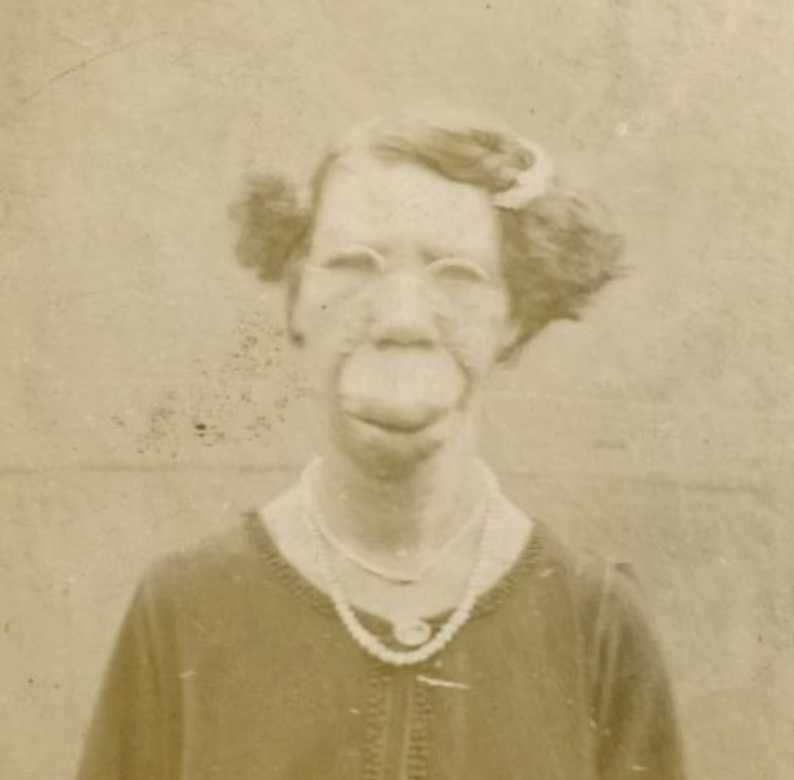
This week we highlighted Grace McDaniel, the so-called “Mule-Faced Woman.” While Grace is well-known, much of what is written about her is inaccurate. Moreover, her very name is nearly always miswritten and misspelled.
Grace McDaniel (1888-1958)
Those interested in the true biographical details in the life of the legendary sideshow performer Grace McDaniels [sic] are beset on all sides by books and websites that re-report the same inaccuracies ad-infintum. In addition, nearly every published source continues to list her name incorrectly as Grace McDaniels, when her proper surname was McDaniel.
Grace was born Grace Mae McCannon in Numa, Iowa in April 1888 and had nine siblings. In 1917 she married Harry McDaniel in Katy, Texas. Harry was a farmer, originally from Vinwood, Alabama and was 11 years older than Grace. On March 21, 1918 they had a son, who they named Daniel Elmer McDaniel, who was known throughout his life as Elmer.
Full article continued here: http://www.showhistory.com, where you will find 10 original images of Grace– including 4 pitchcards, 3-4 never published photos, AND the only color photo of Grace that has ever surfaced.